The Memory Multiplier: How Chasing Words in Spelling Bees Trains Kids to Remember Everything

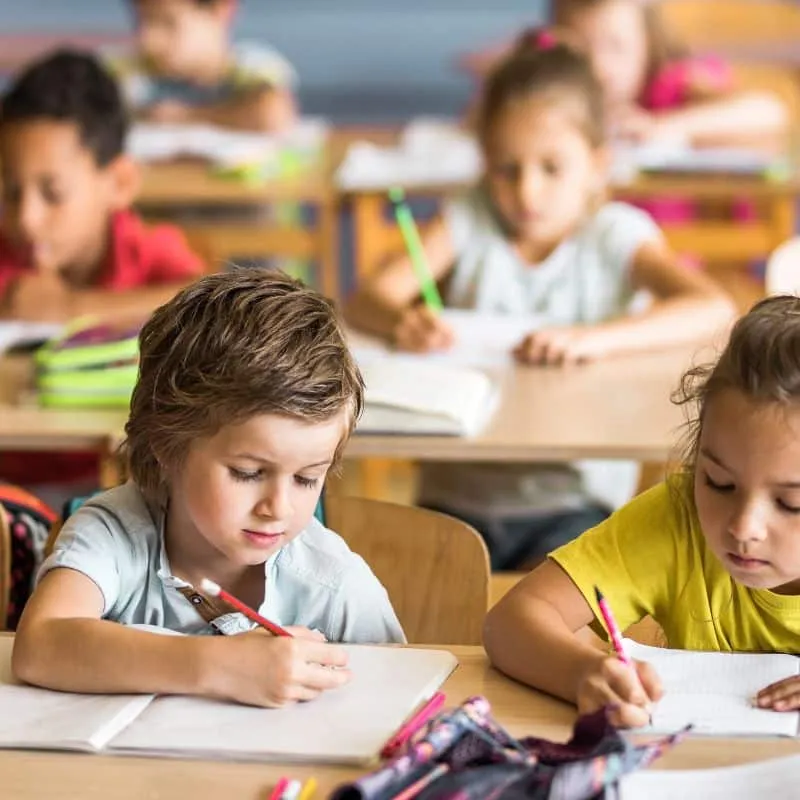
Photo: child studying vocabulary flashcards with books open on desk, via thumbs.dreamstime.com
Ask any spelling bee kid what they remember about preparing for competition, and they'll probably describe something obsessive — flipping through etymology cards at breakfast, whispering Latin roots before bed, mentally dissecting every unfamiliar word they encounter in a book or on a cereal box. It sounds intense. It also turns out to be one of the most effective memory-training regimens a young brain can go through.
Cognitive researchers are increasingly paying attention to what happens neurologically when students engage deeply with competitive spelling. What they're finding is pretty striking: the skills kids build while chasing down difficult words don't stay neatly confined to language arts class. They spill over — into history, science, foreign language, even math. The "spelling muscle," as some educators have started calling it, appears to be strengthening something much bigger than vocabulary.
Pattern Recognition Is the Real Prize
Here's the thing about spelling a word like pneumonoultramicroscopicsilicovolcanoconiosis — you're not really memorizing a random string of letters. You're decoding a system. You're noticing that pneumo- relates to breath, that ultra- signals extreme degree, that -osis indicates a condition. You're reading the word like a map.
That pattern-recognition process is exactly what cognitive scientists get excited about. When kids train themselves to spot recurring chunks — Greek prefixes, Latin suffixes, French borrowings — they're essentially building mental filing cabinets with highly organized drawers. Information goes in with context attached. And context, researchers consistently find, is the engine of long-term memory.
Dr. Robert Bjork, a learning and memory researcher at UCLA, has long argued that effortful retrieval — the kind of mental work where you have to really reach for information — builds stronger memory traces than passive review. Spelling bee prep is basically a masterclass in effortful retrieval. Kids aren't skimming word lists. They're reconstructing words from their roots, testing themselves, getting things wrong, and trying again. Every one of those cycles deepens the neural groove.
When Spelling Habits Show Up in History Class
Talk to middle school teachers in schools where spelling competitions are taken seriously, and a pattern emerges pretty quickly. The kids who compete tend to be the same kids who remember that the word democracy comes from the Greek demos (people) and kratos (power) — and who use that knowledge to actually understand what they're reading in social studies, not just memorize it for a test.
One seventh-grade teacher in suburban Ohio described a student who had competed in regional spelling bees since fourth grade. "She approaches every new unit the same way she approaches a new word list," the teacher explained. "She wants to know where things come from. She looks for the logic underneath. And because of that, she retains information in a way that most kids don't."
That's not a coincidence. When you've spent hundreds of hours asking why a word looks the way it does, you start asking why about everything. The habit of seeking underlying structure — rather than surface-level facts — is one of the most transferable cognitive tools a student can develop.
The Science Behind Retention Across Subjects
Memory researchers talk about something called elaborative encoding — the process of connecting new information to things you already know, rather than storing it in isolation. It's one of the most reliable ways to make information stick.
Spelling bee training is essentially a forced elaborative encoding workout. When a student learns that aquifer comes from the Latin aqua (water) and ferre (to carry), they're not just filing away a spelling. They're building a web of associations — to other aqua- words, to the concept of water systems, to geography lessons they may have had years earlier. That web makes the word — and everything connected to it — easier to recall later.
The same mechanism applies when those students sit down in a science class and encounter photosynthesis. They already know photo- means light. They already know -sis signals a process. The new word lands in a brain that's been pre-organized to receive it.
Researchers at Johns Hopkins have documented how interleaved learning — mixing up different types of information rather than studying one thing at a time — leads to better long-term retention. Spelling bee prep naturally creates this kind of interleaving. A student might study words from biology, law, music, and meteorology all in the same session. Their brain is constantly context-switching, which turns out to be excellent exercise.
Real Kids, Real Results
The anecdotal evidence from families and teachers is consistent enough to be hard to ignore. Parents of spelling bee competitors frequently report that their kids seem to have sharper recall across the board — not just with words, but with historical dates, scientific terminology, foreign language vocabulary, even story details from books read months earlier.
A parent from Atlanta shared that her son, a regional spelling bee finalist at age eleven, started acing his Spanish quizzes around the same time his spelling prep intensified. "He told me it was easy because Spanish words look like they make sense to him now," she said. "He sees the Latin roots and it just clicks."
That's elaborative encoding at work. That's pattern recognition transferring across domains. And it's the kind of cognitive advantage that doesn't disappear after the competition ends.
Building the Habit Early
The encouraging part of all this research is that you don't have to be a national-level competitor to benefit. The memory advantages associated with spelling bee engagement seem to kick in at the level of genuine, curious engagement with words — the kind of engagement that platforms like spelling games and vocabulary competitions are designed to encourage.
When a kid stops to wonder why knight has a silent K, or why colonel sounds nothing like it looks, they're doing the same cognitive work that builds better memory architecture. They're asking the brain to go deeper than the surface. And the brain, remarkably, rewards that effort — not just in the next spelling test, but in every subject that follows.
The words are the entry point. The memory is the destination. And for kids who really chase words, the journey turns out to be one of the best investments their developing brains can make.