Freeze, Breathe, Spell: How to Build the Mental Toughness That Wins Spelling Bees
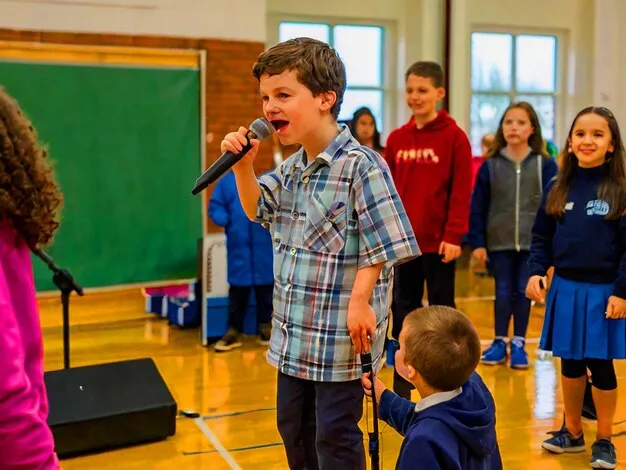
Photo: confident child student speaking into microphone at school competition, via img.freepik.com
You've practiced the word a hundred times. You know it. You know you know it. But then the judge reads it aloud, the gym goes quiet, and every letter you've ever learned evaporates somewhere between your brain and your mouth.
If that sounds familiar, you're not alone — and you're not weak. What you're experiencing is one of the most well-documented phenomena in performance psychology: the confidence gap. It's the space between what you're capable of and what you can actually deliver when the pressure spikes. And for spelling bee competitors across the country, closing that gap is just as important as memorizing root words.
What's Actually Happening in Your Brain
Let's get a little nerdy for a second, because understanding the problem is half the battle.
When you step up to that microphone, your brain doesn't always know the difference between "spelling bee stage" and "actual danger." The amygdala — your brain's alarm system — can fire off a stress response that floods your body with cortisol and adrenaline. Heart rate spikes. Palms sweat. Working memory, the mental workspace where you're trying to sound out letters, gets crowded out by noise.
Dr. Leah Kimura, a sports psychologist who works with youth competitors in the Chicago area, calls it "neural hijacking." She explains it this way: "The emotional brain temporarily overrides the thinking brain. A student who could spell 'pharynx' perfectly at home suddenly can't access that information because their system is in threat mode."
The good news? You can train your brain to respond differently. Elite athletes do it all the time.
The Athlete Parallel Nobody Talks About
Here's something that might surprise you: the mental preparation routines used by Olympic gymnasts, free-throw shooters, and professional golfers translate almost perfectly to competitive spelling.
Think about a basketball player at the free-throw line with two seconds left in a tied game. The crowd is screaming. The stakes are enormous. And yet, the best players in the world go through a deliberate pre-shot routine — a bounce, a breath, a focal point — that essentially tells their nervous system: we've been here before, we know what to do.
Spellers can build the exact same thing.
Marcos Delgado, a 14-year-old from San Antonio who placed in the top 20 at a regional competition last year, figured this out almost by accident. "I started doing what my soccer coach taught me before penalty kicks," he says. "Three deep breaths, picture the ball going in — except I picture the word spelled out correctly. It sounds kind of dumb but it actually works."
It doesn't sound dumb at all. What Marcos stumbled onto is a technique psychologists call performance visualization, and the research behind it is rock solid.
Visualization: Your Mental Dress Rehearsal
Visualization isn't daydreaming. It's deliberate, structured mental rehearsal — and when done right, it activates many of the same neural pathways as physical practice.
For spellers, here's a simple version to try:
Step 1: Find a quiet spot and close your eyes. Take three slow breaths — inhale for four counts, exhale for six. That extended exhale is key; it activates the parasympathetic nervous system and physically slows your heart rate.
Step 2: Picture the spelling bee environment in detail. The gym, the chairs, the judges' table. The sound of the microphone. Make it as real as possible.
Step 3: Now see yourself walking to the mic — calm, focused, ready. Hear the word. See yourself asking for a definition, using it in a sentence, taking your breath. Then spell it. Correctly. Confidently. Hear the bell that signals you got it right.
Step 4: Let yourself feel that moment. The relief, the pride, the focus. That emotional anchor is what your brain will reach for when the real moment arrives.
Dr. Kimura recommends doing this for five to ten minutes before bed during competition prep season. "You're essentially pre-loading a successful experience," she says. "So when the actual event happens, your brain goes, 'Oh, I've done this. I know how this goes.'"
Breathing Is Not Just for Yoga Class
If visualization feels like too much of a commitment right now, start with breathing. Seriously — it's the fastest, most accessible mental reset tool available, and it requires zero equipment.
The technique that keeps coming up in both sports psychology research and anecdotal reports from competitive spellers is box breathing: four counts in, four counts hold, four counts out, four counts hold. Repeat two or three times. Navy SEALs use it before high-stakes missions. You can use it before stepping to the mic.
Another option: the physiological sigh, which researchers at Stanford have identified as the quickest way to reduce acute stress. It's a double inhale through the nose (a short sniff followed immediately by a longer one), then a long, slow exhale through the mouth. One or two of these can measurably calm your nervous system in under 30 seconds.
Practice these at home — not just during stressful moments, but regularly, so the technique becomes automatic. You want it wired into your muscle memory before you ever need it under pressure.
Reframing the Mic
One of the most powerful shifts a competitor can make is changing the story they tell themselves about what the microphone represents.
For many kids, the mic is a judgment zone — a place where failure is public and humiliation is possible. That framing almost guarantees anxiety. But what if the mic is a stage? A showcase? A chance to demonstrate something you've genuinely worked hard to earn?
Language matters here. Sports psychologists call this cognitive reappraisal — deliberately choosing a different interpretation of the same situation. Research consistently shows that people who reframe anxiety as excitement ("I'm pumped up" rather than "I'm nervous") actually perform better. The physiological sensations are nearly identical; the label changes everything.
Try this before your next practice round: instead of saying "I hope I don't mess up," say "I get to show what I know." It feels awkward at first. Do it anyway.
Building Reps in Practice That Mimic Pressure
Here's the thing about mental toughness: you can't just read about it. You have to practice under conditions that feel uncomfortable.
If you only spell words at your kitchen table in your pajamas, the spelling bee stage is going to feel like a completely foreign environment. So manufacture pressure in practice. Spell in front of your family at dinner. Ask a teacher to quiz you in front of the class. Use platforms like Spelling Bee The Game to simulate timed, competitive formats where the stakes feel real even when they aren't.
The goal is to accumulate enough reps in uncomfortable situations that the real competition starts to feel... familiar. Not easy — familiar. That distinction matters.
The Long Game
Building mental resilience doesn't happen overnight, and one bad round at a competition doesn't undo everything you've worked for. Some of the most decorated spellers in the country have a story about freezing up early in their career. What separates them isn't that they never felt the pressure — it's that they learned to work with it instead of fighting it.
Your brain is trainable. Your confidence is buildable. And the next time you walk up to that microphone and hear a word that makes your stomach drop, you'll have a toolkit ready.
Breathe. Visualize. Reframe. Spell.
You've got this.